
What Vets Wish Small Dog Owners Knew


Small dogs are not simply small versions of big dogs. Ask any vet and you will hear the same thing: the problems they see in Cavaliers, Shih Tzus and Yorkshire Terriers are a category of their own — and many are preventable.
I care exclusively for small companion breeds here in Amersham, so this is a conversation I have almost every week with dog owners. Here is what vets most often wish owners knew.
Little bodies, big differences
Weight is the first thing most vets mention, because the maths of a small dog is unforgiving. One extra kilogram on a seven-kilogram dog makes the dog 17% overweight, and the proportional equivalent of an average adult putting on 25-30 pounds. Tiny treats high in calories or fat can quietly ruin the daily balance. So, vets would rather see portions measured than judged by eye, with treats counted in the daily total.
Teeth are the second point. A small dog has the same number of teeth as a larger dog, such as a Labrador, packed into a fraction of the space, so crowding is inevitable; tartar and plaque build-up happens fast. Professional cleaning requires an anaesthetic and is expensive and always carries a risk; two minutes of daily brushing costs next to nothing. Left untreated, dental disease causes painful tooth loss, gum disease and strains the heart and kidneys.
The collar habit worth breaking


If there is one habit vets would change, it is walking a small dog on a traditional neck collar. A dog that pulls is putting all that force through a windpipe roughly the width of a drinking straw, and collapsing the trachea — that honking, goose-like cough — is more common than owners realise. A body harness spreads the pressure across the chest instead.
Their frames are delicate in other ways. Jumping down from a high sofa is a routine cause of injuries in toy breeds such as Yorkshire Terriers and Pomeranians, and a small ramp removes the risk. Luxating patella — a kneecap that slips out of position — is also common; the sign is a skipped step or a sudden hop on a back leg, and physiotherapy often helps if caught early.
Most dogs live for fetch. Throwing a tennis ball seems like the perfect way to burn off energy, but those popular plastic ball launchers might be doing more harm than good.
When a launcher jettisons a ball across a field, your dog builds up extreme, unnatural speed. To catch it, they slam on the brakes, twist, or stop short. This high impact twisting and braking puts massive stress on their joints. It can lead to severe, painful injuries like luxating patellas (slipped kneecaps) and torn cruciate ligaments (ACL tears) which often require expensive surgeries with long, painful recoveries.
You don’t have to stop playing fetch entirely, but for safer play, ditch the launcher. Stick to throwing the ball with your arm to keep the distances reasonable and your dog’s joints safe.
Vets also ask owners to notice subtle shifts: a change in sleeping patterns, toileting indoors, or a hesitation before jumping onto the sofa is often the first sign of joint pain.
They are real dogs, not tiny accessories

Behaviour is where size does small dogs the most harm. A growl from a five-kilogram dog gets laughed off as cute in a way it never would from a Labrador, but it means the same thing: this dog is frightened, and it deserves proper positive-reinforcement training. Treating a small dog as a fragile accessory rather than a dog tends to produce an anxious, insecure animal — all dogs thrive on structure and routine.
Early socialisation means far more than meeting other dogs. Gently introducing a puppy to new people, busy pavements and roads, being handled and brushed, and having their nails trimmed builds confidence they will draw on for life. Vet visits are a regular fixture. Staying relaxed at the clinic helps too: dogs read human body language faster than we credit.
Breed instincts do not shrink with body size, either: terriers still want to sniff out vermin, and boredom is what turns into chewing, digging and barking. Let a walk be a walk — stopping to sniff is stimulation, which is why jogging with a small dog is much less enriching for a small dog than it might seem.
If your dog struggles when left alone, do mention it to your vet rather than waiting it out. Separation anxiety is treatable, and I’ll Be Right Back is an excellent book on this topic. Choosing the right care while you are out matters just as much — I wrote about what to look for in a dog sitter last month that you can refer to for guidance.
The hazards at your dog’s level
This section surprises owners most, and it comes down to height. Deodorants, aerosols and perfumes do not simply vanish when used — they drift downwards and settle close to the floor, which is precisely where a small dog lives, sleeps and breathes. Over time that can contribute to asthma-type conditions, skin allergies and conjunctivitis. The fix is simple: do not spray these products in the rooms where your dog sleeps or right above your dog.
Scented candles, plug-ins and cleaning products deserve the same caution. Several of the scents used most often in them — peppermint, cinnamon, clove and citrus among them — are toxic to dogs, irritating the airways and, with enough exposure, affecting the nervous system.
As the weather turns, two seasonal poisons are worth knowing by name. Antifreeze is sweet-smelling, which is exactly why dogs are drawn to it, and lethal in very small quantities; slug pellets are the other autumn hazard. Small dogs are opportunists in general — wine corks and children’s dummies are perennial favourites — so if your dog starts vomiting, ring your vet rather than waiting to see.
Vets would rather prevent than react, too: keep flea, tick and worming treatments up to date year-round, and book the annual health check — many insurance policies are invalidated without one.
What all of this means for the dogs in my care
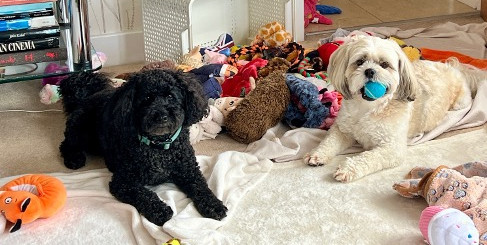

When someone searches for dog kennels or a dog hotel near them, what usually comes to mind is a row of runs and a lot of noise. Lap of Luxury is neither — I am a licensed home boarding and daycare, run from and in my own home in Amersham, for small companion breeds only.
Dogs are walked in a body harness, not by their collar. Meals are measured rather than guessed at, and I keep to whatever you and your vet has advised. I always take instructions for food and medicine in writing; never verbally. The only room scent I use is a bit of lavender – perfectly safe for dogs. Numbers stay small, the dogs are calm, and it always starts with a meet-and-greet so I can learn your dog’s routine and what worries them before they ever stay.
Amersham sits at the heart of the Chilterns and is within easy reach of a wide area — I regularly look after dogs from Beaconsfield, Chesham, Gerrards Cross, Great Missenden, Berkhamsted, Chalfont St Giles, Chalfont St Peter, Hazlemere, Hemel Hempstead, Holmer Green, Hyde Heath, Little Chalfont, Penn, Prestwood, Rickmansworth and Wooburn Green,
as well as Amersham itself.
Come and meet me first
If you would like to talk through your dog’s routine, or arrange a trial day of small dog daycare in Amersham, I would love to hear from you. There is no obligation — a meet-and-greet is simply the best way to see whether your dog is comfortable here.


Comments